FIFI Is Gone
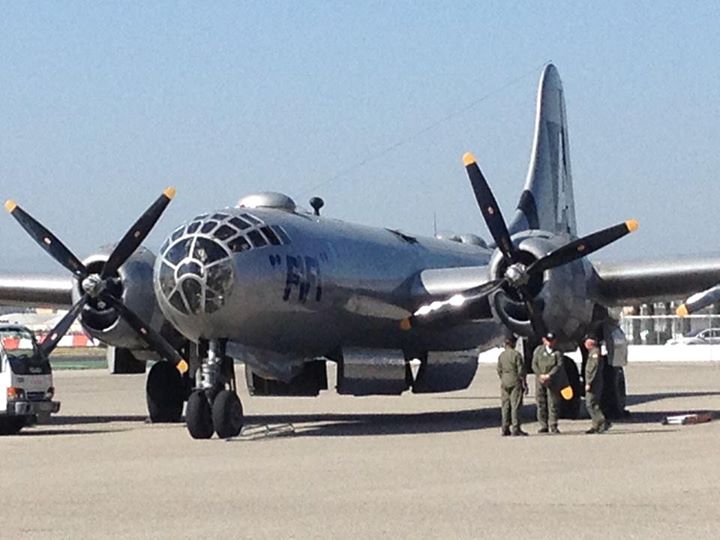
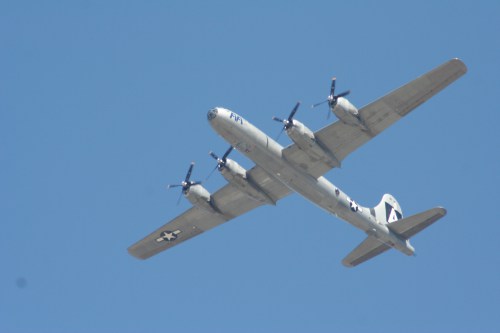
Fifi left for Palm Springs on March 9th, and will remain there until the 16th. THANK YOU FIFI FOR BRINGING YOUR HISTORY TO CAMARILLO!!!!

Fifi left for Palm Springs on March 9th, and will remain there until the 16th. THANK YOU FIFI FOR BRINGING YOUR HISTORY TO CAMARILLO!!!!
Fifi is expected to be here this afternoon – check with us to see what the current schedule is. We’re waiting on weather updates!

The Worlds only flying B-29, FIFI, is coming to Camarillo March 2 through March 9, 2015. She will arrive at approximately 12 Noon on the 2nd and depart for Palm Springs at approximately 12 Noon on the 9th. Call 805-482-0064 for more information about this opportunity to see the worlds only flying B-29
Our Museum is hosting a private event on Saturday evening June 13th so we will be closing at 3 pm.
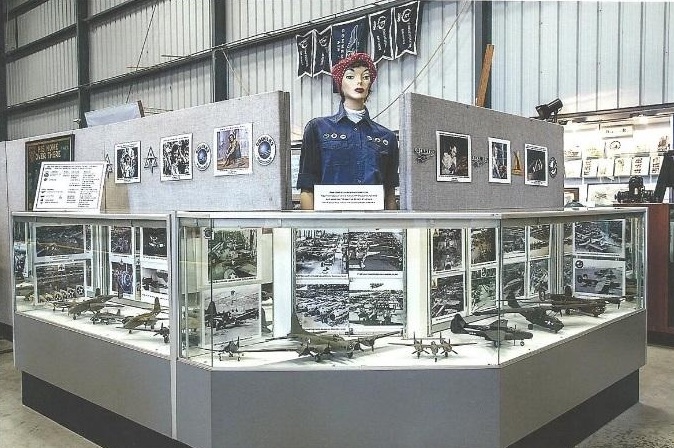
The newest display in our Aviation Museum is devoted to not only the So. CA aircraft manufacturers, but also to the “Rosie the Riveter” ladies who helped build the aircraft during World War II. Kudos to Charlie Carr and crew for this great display! Come check it out!
Camarillo, CA – In the spring of 1981, the CAF Southern California Wing was formed in the greater Los Angeles area by a small group of CAF members, who gathered together with a dream. Ron Fleishman and Clay Lacy were among that small group. They are still CAF So Cal Wing members. I don’t think they had any idea that this CAF unit would ever be as successful and active as we are today. Most of us didn’t know each other before we started but we quickly found we had the same dream and a real “can-do” attitude. The C-46 Commando Transport was available in Conroe, Texas. It needed two new engines, but it was available if we could get the engines and fly it out. That took a member with a $10,000 no-interest loan to step up, and Ron Fleishman with a crew of aircraft mechanics working almost every weekend during the summer of 1981 in hot and muggy Conroe, TX to procure the new engines and then hang them on the plane. That “can-do” attitude kept them going. We needed an airplane that could haul our members to air shows so we could set up a PX, give tours of the aircraft, and make some money. For many years the C-46 fulfilled that chore until the price of fuel became a problem we could not control. There are only eleven members of the Wing today who were members in the spring of 1983. I don”t have a roster from 1981, but if I did, we would probably find only four or five members still active who were members that year. Most of the early members have passed away. There are many funny stories that we could tell, and many great memories to cherish. The talent among the members is amazing, but the “can-do” attitude has been one of the major attributes that kept us all going. We have received many awards from CAF Headquarters for our major successes.
The following are some of many major milestones in our journey together through the years:
Moving the C-46 transport to Camarillo Airport in June,1982
Seven women in the So Cal Wing were among the first women to become CAF Colonels in July, 1982.
Becoming a CAF Wing in September, 1982
Hosting a banquet for Chuck Yeager at the Airtel Hotel Grand Ballroom, Van Nuys,CA September, 1984
Stripping paint off the C-46 in 1985
Changing name of C-46 from Humpty Dumpty to China Doll in 1986
Moving to the old Nose Hangar from east end of Camarillo Airport in October, 1986
Receiving donation of SNJ-5 #290 from ten So Cal Wing Members
Accepting artifacts from the public setting up displays in our small Aviation Museum and inviting the public to visit
Participating in the Camarillo Air Shows, and in air shows all around Southern California, and sometimes in other parts of the country.
Acquiring all the great warbird aircraft through the years.
Accepting the artifacts and display cases from the Goleta Aviation Museum.
Building the two hangars in 2000-2001.
Accepting the artifacts and display cases from the Museum of Flying in Santa Monica.
Over the years, our aircraft have been featured in many aviation publications, including: calendars, books and magazines. Our aircraft have been used in movies and TV commercials. We flew the C-46 in circles over the 1980s Grand Opening of the Spruce Goose display in Long Beach. We have taken the China Doll to Kalamazoo, Michigan and St. Paul, Minnesota once; and to EAA’s Airventure in Oshkosh, Wisconsin three times for air shows. We have been up and down the Western States to air shows many times over the years. Our Japanese Zero fighter and pilots went to Wanaka, New Zealand to be the main event aircraft at the famous “Wings Over Wanaka” air show several years ago. We have more flying aircraft than most of the CAF units, and we are one of the most active units in aircraft restoration and maintenance. Earlier this year, our Wing was again awarded a national Distinguished Unit Citation by the CAF Headquarters or an outstanding record of accomplishments on aircraft maintenance, restoration, flying record accomplishments and a fund raising program to expand and build additional hangars and a new museum building at its facility. The So Cal Wing has had more success with our Cadet Program for teenagers than other units. The Wing was one of the first units in the CAF organization to start a Cadet Program, with Steve Barber,Jr. when he was a teenager. The members of the Southern California Wing CAF should all be very proud of what they have accomplished over the years and all with volunteers!
The CAF So Cal Wing is a non-profit, self-supporting, tax-exempt, all volunteer organization honoring American military aviation through flight of restored WWII aircraft, educating young people about aircraft history and keeping alive the memory of those who served our country.
# # #
For further information contact: Pat Brown, PIO, 805 479-2221 or Mike Greywitt, PIO 805 908-1548
This new exhibit in progress at the Aviation Museum of the CAF So Cal Wing at Camarillo Airport is dedicated to the Moms who held down the fort at home during WWII while their sons, husbands, fathers,brothers and other family members were off to the war effort.
Many of the children and relatives of “Moms at home in WWII” display remember the sacrifices made from saving newspapers, aluminum foil, and other strategic items for the war effort. There were also rationing books, and food ration coupons where you could only buy a certain amount of eggs, meat, etc. Some remember Moms mixing up what was called oleomargarine, using lard and a soft gel coloring to make it look better.
There were also black draw-down shades in many windows along the Southern California Coast and Los Angeles Basin so no light could get out the windows at night providing a potential enemy target. This occurred right after a Japanese submarine surfaced on February 23, 1942 a few hundred yards off a beach 10 miles west of Santa Barbara, CA, within the Ellwood Oil Field. For 20-minutes, the sub fired 17 shells at the giant Richfield aviation fuel storage tanks, did only minor damage to a pier and pump house, but news of the shelling trigger an Invasion” scare along the West Coast. It was the first enemy ship to shell the U.S. mainland.
Come on down to our Aviation Museum at 455 Aviation Dr., Camarillo Airport and check out our expanded museum and gift shop – and be sure to bring your Mom if she is still with you to see the new “Moms in WWII” display. Open Tuesday through Sunday, 10 am to 4pm, closed on Mondays.
© Photos by Ken Gottschall
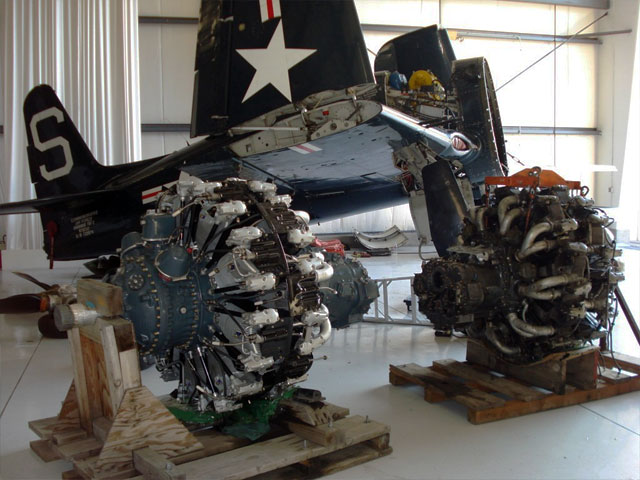 The old Bearcat engine (right) is off and the new one (left) is ready to go on the airplane. Thanks to the hard work of Ken Kramer, Ken Gottschall, Mike Perrenoud, Gary Barber and other volunteers from our Camarillo location, the work at Burbank Airport is progressing.
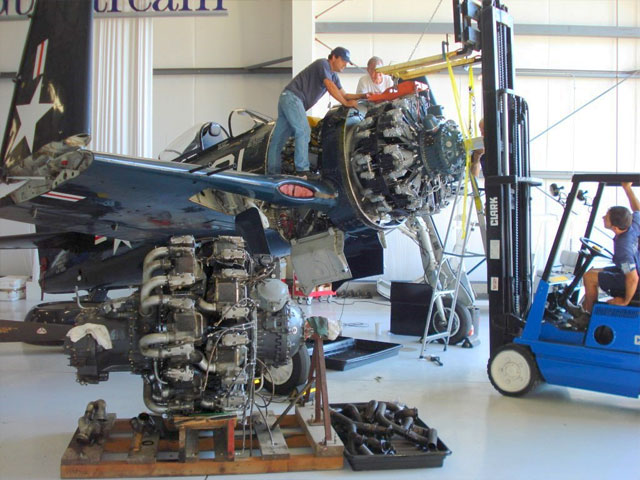 Believe it or not! Here’s the new engine already installed on the aircraft! Doesn’t she look beautiful? The guys are just outdoing themselves in the pace of work they have exerted to get to this point in such a short time. Kudos guys!
It was a day like any other day, except I was there!
by Steve Barber
My apologizes to Walter Cronkite in the title, but this is a little story of what can happen – and how best to prepare for it if in fact it does occur.
Saturday, March 28th, 2009 – Jason Somes in the F6F Hellcat, Ken Gottschall in the A6M-3 Zero and I, your trusted story teller, in the F8F Bearcat – had just finished our final formation fly-by at the close of the Riverside, California Air Show and turned west for home, Camarillo, California.
Ken, being chosen as lead in the Zero, had dialed up So Ca Approach. We were assigned our squawk code, and requested a climb to 6500 feet. Our selected route of flight would take us northwest until over the 210 freeway, then almost due west, direct to Camarillo Airport. Our formation was somewhat spread-out in trail after our final pass, as we had all settled down and were selecting climb power, cowl flap positions, oil-cooler door positions, temps and pressures. Once these items were satisfactory, it was time to level out in cruise.
With Ken handling the radios and squawk codes, Jason and I were free to look around and enjoy the ride. We were cruising in loose formation with me in the Bearcat as #3 on the left and in trail of #2. A few minutes after our turn westbound, I felt that the engine was not “feeling” right. What do I mean by not “feeling right?” I can only tell you that I sensed a decrease in horsepower. I scanned all of the gauges and all readings appeared normal. Oil pressure, oil temperature, manifold pressure, R.P.M.’s. I was about to key my mike and ask my wingmen if they noticed anything.
Before I could do so, Ken called me to say, “Bearcat, you are really putting out black smoke!” My first thought was that the AMC on the carburetor had failed and gone full rich – which might explain the black smoke. I’ve had this happen on other round engines, and you can help it by manually leaning way back on the mixture control. I tried this and nothing changed, neither in the smoke volume, as verified by Ken and Jason, nor in a perceived increase in engine power by me.
We were coming up on the Rose Bowl at about this time, and Ken had called So Ca Approach to tell them one of our flight was having a problem and at the same time he had come close to me to check underneath to see if he could possibly tell me anything about what was happening to the Bearcat. As he was telling me what he was seeing (very heavy black smoke), my engine really started unwinding. Ken said it looked as if I went into reverse as he went way in front and under me. So Ca Approach wanted to know my intentions. I said, “Land at Burbank now!” They asked me “what runway do you want?” I replied, “what are the winds?” They came back that they were out of the south. I said “I’ll take 15.” They replied that I was cleared to land on any runway. Now all I had to do was make it.

© Photo by Frank Mormillo
Steve is trying to fly the Bearcat to Burbank Airport to make an emergency landing. I should add that while all this was going on, I had begun a shallow climb while the engine was still making some power. If I remember correctly, I got to just a little over 7000’ when the engine quit making any noticeable power, and down I came. So Cal Approach called to give me a squawk code – which I entered on my transponder as up to then I was on standby on the transponder as Ken was Lead and squawking for the flight. I remember at the time feeling irritated that I had to change my focus of making the airport to enter a code on the transponder. Funny how you remember things at this time of high stress.
When the engine began losing major power, the smell of hot oil permeated the cockpit, and I was ready to start hitting the fire bottles that Ken Kramer and crew had installed in the Bearcat – utilizing 3 separate Halon bottles. Engine fire is a big problem in the F8F due to the fact there is no real firewall, and the aileron control rods are directly behind the engine and would be the first to fail in event of a major fire.
Ken Gottschall then called to tell me that the engine was now putting out white smoke in large amounts. Shortly thereafter, the smell of hot oil was replaced by the smell of hot metal. Now I’m thinking, “Great, if I bend this airplane Ken Kramer, my brother Gary, Joe Peppito, and the rest of the Wing will kill me if I survive!”
Best rate of glide speed in the Bearcat is 140 knots clean – that is gear and flaps up. Now I’ll tell you this, it is amazing how fast that Bearcat can descend with a slowly turning propeller, and the short wingspan of this aircraft. I was turning downwind for runway 15, and my altitude was about 3000’. I selected gear down, as I was afraid of the engine seizing and then having to do a manual extension of the gear with little time to do so. Boy, did this increase the rate of descent! Just as I passed the runway touchdown zone I turned base. “Still high,” I thought, I selected 20 degrees flaps. What I noticed was how, with the gear down, flaps at 20 degrees, and the propeller barely turning, the trajectory was that of a “greased crow bar.” As I remember it – the biggest problem I was having was maintaining 100 knots once the gear was extended.
While I was concentrating on arriving at the airport safely, Approach called me several times to contact the tower. Now folks, the last thing I was going to do was take my eyes off of my landing area, distract myself with any non-essential items, so I did not answer them. Again, going through my mind was, “Boy, I’ll bet the tower or approach will be pissed at me!”
I had by this time cranked in full nose up trim and the stick was still nose heavy. In very quick order, I pulled back to round out the landing, the airplane arrived solidly on the runway in a three-point attitude. At the same instant the Bearcat touched down, the propeller seized. I turned off the mags, mixture to idle cut-off, master switch off – while I was rolling out on the runway. I knew they had closed the airport to other traffic for my landing, and my intent was to clear the runway if able to on the roll-out. As I made a right turn off of the active runway, a fire truck was entering right where I wanted to clear the active beyond the “hold short line.” The fire truck saw there was no fire, guessed what I was trying to do, and put his truck in reverse. However, by this time I had begun braking, seeing him coming at me. Long story short – I didn’t make it totally clear of the active runway.
I rechecked the switches, un-strapped, unplugged and jumped out. The fire trucks were checking the aircraft over and found no fire, and waited around for 20 minutes just to be sure.
A few more items I’d like to relate to the readers of this narrative: my wing-men did all the right things. First, they alerted me to my aircraft smoking. Secondly, they coordinated with Approach and relieved me of most of the radio work. Third, they followed me down all the way to my touchdown in case I needed any help. And lastly, they landed after I was safely on the ground to check on me and the aircraft.
Things I could have done better: if you are flying formation, fly forward enough so that lead can just look out to see your position, and give you a heads up if he sees anything wrong. I was too far back at first trying to figure out if I had a problem. Secondly, as I was down to 1600 R.P.M.’s, I didn’t try to pull the propeller back anymore than where I had it set. As this was an Aeroproducts propeller, oil was not necessary to govern R.P.M.’s – as long as the engine was still turning. Therefore, I might have picked up a little better glide ratio. Lastly, Jason tells me I didn’t land on the center-line of the runway. Picky…picky!
Make sure your plane is fully serviced! I had 17.5 gallons of oil on departure from Riverside, and once the problem started up to the landing, all of the oil was gone! This occurred in a time of less than 7 minutes! Just imagine what could have happened if I had flown with minimum oil. Failure could have occurred much sooner – without the landing option I had. Oil pressure and temperatures were all in the normal range until the last 3 minutes.
Kudos to So Ca Approach for a very professional job. Ditto to the fire department at Burbank Airport and to all of the airport personnel for the friendly and professional way that they dealt with me. And lastly – to Millionaire Aviation, who assisted us with towing the aircraft to a safe parking area. Speaking of the tower (remember Approach telling me to contact them) – the airport manager asked that I call them as they wanted to talk to me. He gave me the number and as I dialed my phone I thought, “Here comes my ass chewing.” When the tower chief answered he asked if I was the pilot, and I said “yes.” He said, “Great job, sir! We’re glad you are all right.” Talk about class – my thanks to all for a wonderful assist.
Editor’s Note: I can speak for the whole Wing when I say we all let out a huge sigh of relief to hear that Steve was down and safe in Burbank!
When I teach transition into high performance fighters (for that matter any aircraft) – I harp at the students: speed and altitude are your friends! You can be low to the airport environment, but you either need to have the runway made or be going at the “speed of stink.” You can be slow, but you better be high if you need to translate that altitude to speed. Nothing gets me harping on pilots more than a long drawn-out final, with gear and flaps down. You have no chance if the worst happens. Speed is life, and in our high-performance aircraft, you can take that to the bank!

© Photo by Frank Mormillo
Steve Barber has brought himself and the Bearcat down safely at Burbank Airport!